
Author’s Note
What follows truly happened not constructed. Time has been compressed, names removed, and surfaces deliberately smoothed. The setting is incidental; the encounter is not. This is less a record of events than of alignment—of how proximity can reorder meaning. Read it not for answers, but for the moment when something shifts.
Yesterday was Saturday
Saturday mattered, because Saturdays carry assumptions. They promise slack, delay, the luxury of postponement. Yesterday broke that promise early. The room did not recognize weekends. It recognized only process. White light. Soft alarms. Tubes arranged with professional indifference. Blood moved according to schedules decided elsewhere.
He lay still, cooperative, letting the exchange happen. The body accepted it. The mind refused to stay put. The mind had already moved ahead. It contemplated a near future filled with acronyms and careful explanations. Too many confident voices pointed in different directions. Fear did not enter loudly. It entered as intelligence. It calculated. It branched. It asked reasonable questions that had no stable answers.
Yesterday was supposed to be routine. A day visit. In and out. Temporary. Yet even as it unfolded, the body sensed something else. A hinge. A narrative shift. Saturdays, after all, are not meant for this kind of clarity.
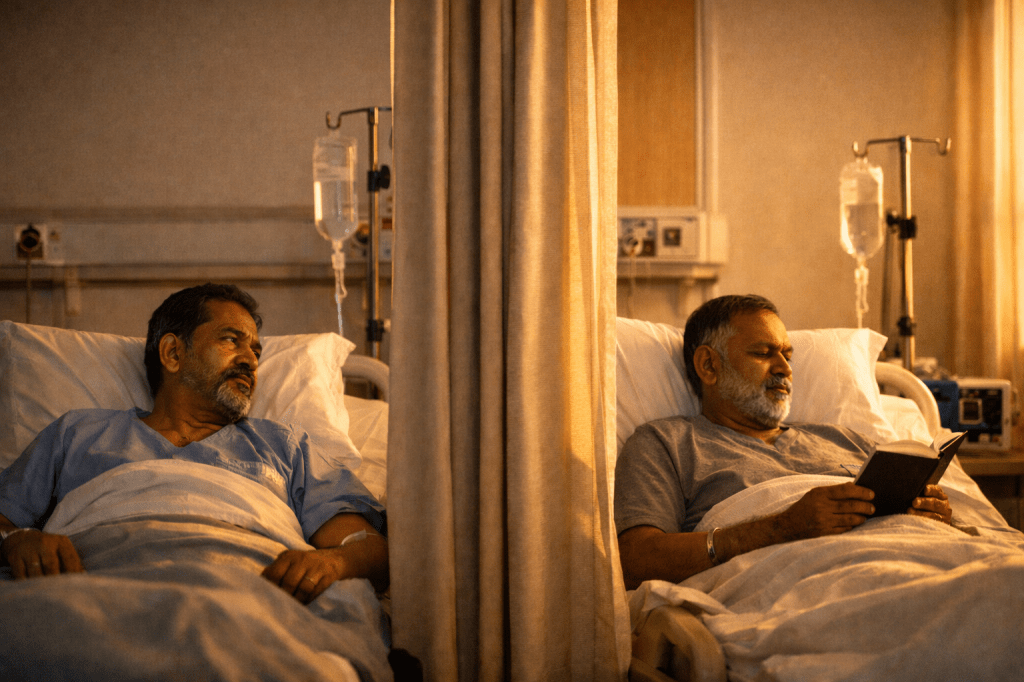
In the bed next to him lay another man. Wired into the same choreography, yet curiously unsuspended. A laptop sat open on the tray, quietly defiant. Not a device for distraction, but for continuation. His fingers moved with unhurried certainty, the way they do when time still belongs to the person using it.
The screen showed layers—patterns stacking upon patterns. Music, perhaps. Or something equally intentional. Whatever it was, it was creation. In a place devoted to maintenance and repair, something new was being assembled.
The watching began without consent. Not curiosity—something sharper. Recognition edged with envy. Not envy of health, but of authorship. One man lay waiting. The other insisted on forward motion.
Curtains divided the space, but they were symbolic at best. Lives leaked across them easily. Afternoon slid into evening. And then, yesterday, something quietly decisive happened. The man with the laptop spoke first. A simple question. Ordinary. Human. It passed the machines without resistance.
Conversation followed as if it had been waiting all day.
They began where people begin when they want solid ground—work. The same broad world, it turned out. Technology. Systems. Abstractions. Their paths diverged, but the ecosystem was shared. Names surfaced. Connections aligned. The professional graph collapsed neatly, obedient to pattern.
A detail appeared—small but precise. The helper nearby belonged to a familiar giant of the industry. Yesterday had a way of compressing improbability into normalcy.
They spoke of interests next, of curiosity as something that persists even when the body renegotiates its terms. The conversation moved by gravity rather than intention. Inevitably, it reached the territory neither had named but both recognized.
The man with the laptop said—plainly, without drama—that he had undergone the same procedure now occupying the other man’s thoughts.
Once, the listener assumed.
Twice, the speaker clarified.
Nothing in the room reacted. Machines did not pause. Numbers remained loyal to themselves. But internally, a structure gave way. Until yesterday, the procedure had existed as abstraction—stitched together from warnings, statistics, and stories that darkened in retelling. Yesterday, it acquired a body. A voice. A posture.
Someone who had crossed—twice—and returned not as metaphor, but as fact.
They spoke of marrow and medicine. Of treatments that work and those that retreat quietly. Of blood borrowed on trust. Of trauma not as event, but as residue. No advice was offered. None was required. Experience, when shared honestly, does not instruct—it reveals.
Silence followed. Not empty. Complete. And then the reference arrived, unmistakable and spoken aloud, yesterday, without irony: The Bucket List—the movie.
Two men. Different lives. A clock that stops behaving politely.
Yesterday, The Bucket List stopped being a film and became a frame. Not about spectacle or checklists, but about authorship. About who gets to hold the narrative voice when time shortens its sentences. About choosing intention even when movement is constrained.
The irony was precise. The man who had crossed the fire twice was still composing, still building. The man preparing to cross was learning something quietly radical—that courage rarely announces itself. It arrives sideways. It sits nearby. It types.
By the time evening settled yesterday, the room had done what it always does. It returned to its indifferent rhythm. Machines were loyal to their beeps. Curtains fell back into place. Nothing was visibly altered. Fear lingered longer than hope ever does. It whispered statistics, rehearsed failures, and reminded him that stories are easier than outcomes. For a moment, the movie The Bucket List felt like fiction again—two actors, a script, a safe distance from consequence. And then, quietly, the distance collapsed. A man sat in the bed next door. He had crossed that very line twice. He was still composing, still present, and still stubbornly alive. In that recognition, something shifted. Fear did not disappear, but it stepped aside. Darkness gave way not to certainty, but to possibility. Somewhere between yesterday’s last drip and the long walk home, a list began to form. It was not written, not dramatic, and not deferred. It was just a resolve to live deliberately. This resolve unfolded one authored day at a time, starting that Saturday itself.


 MindsWideOpen.In - AI ⚡ AI 🚀
Leave a reply to Anonymous Cancel reply