
These notes are distilled after listening across Satya Nadella’s keynotes delivered in multiple Indian cities during this visit — patterns observed, not quotes collected.
This was not a feel-good India visit. It was not a tour meant to praise talent or flatter ambition. Satya Nadella did not come to admire what India is. He came to debug how India thinks, works, and builds. What he delivered was not motivation. It was architecture.
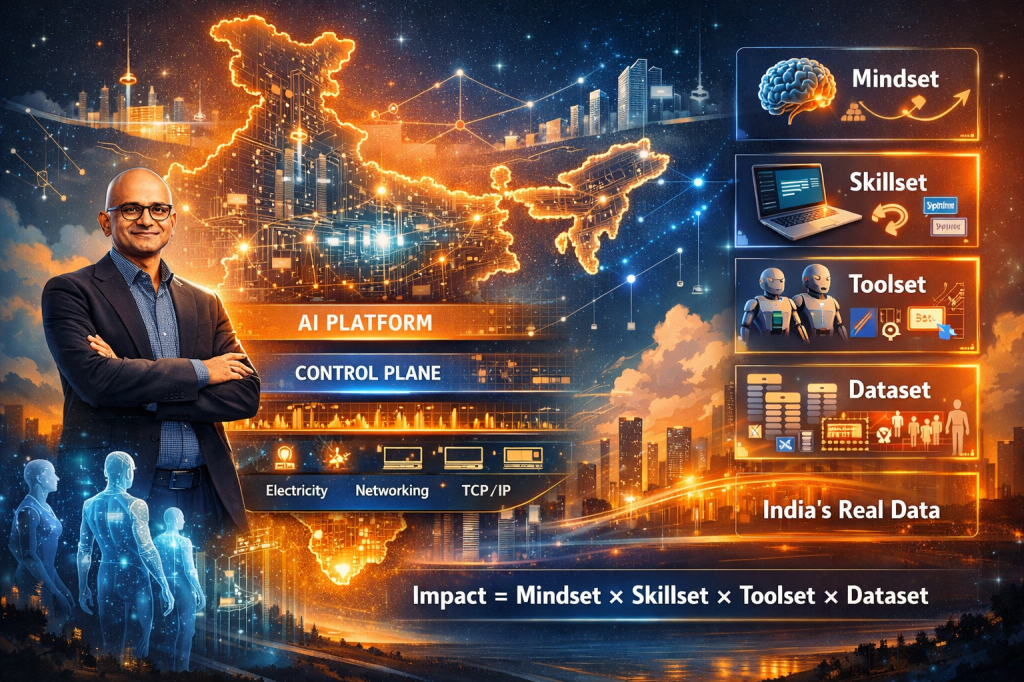
The most uncomfortable idea he left behind was also the simplest: AI is no longer an application. It is no longer a chatbot, a feature, or something you “try out.” AI has quietly slipped below the application layer and is settling into the platform and the control plane. Like electricity. Like networking. Like TCP/IP. There is no opt-out and no drama in this shift. It just happens, and everything reorganizes itself around it.
This is why clapping at Copilot demos misses the point entirely. Copilot is not a feature. It is a behavioral hack. It is a policy-aware AI runtime embedded inside existing workflows, trained on your context rather than on generic internet wisdom. Technically speaking, it is AI acting as a contextual co-processor. There is no new user interface and no retraining of humans. Productivity inflates silently. That silence is what makes it both dangerous and elegant.
Azure’s role in this story is often misunderstood. It is not winning by being flashy or loud. It is winning by already being there. Identity, data, compute, governance, models, and agents are converging into something that looks less like cloud and more like an operating system strategy. Windows déjà vu, except this time the applications are not programs. They are agents.
Satya was careful with hype words, but agents were everywhere in what he said. Models think, but agents act. They decompose tasks, call tools, retain memory, and execute workflows. For India, this is not an abstract idea. Services combined with agents become software-defined labour. BPO, KPO, and IT services now face a simple choice: evolve or fossilize politely.
The most important idea he shared was also the one most people missed. He did not stop at mindset or skillset. He offered a four-variable system.
Mindset is the root variable: growth, comfort with ambiguity, and the willingness to unlearn. If mindset remains constant, output is capped no matter how advanced the tools are.
Skillset is the most overrated obsession. Everyone is learning Python, prompting, and LLM wrappers. The reality is that the half-life of a skillset is roughly eighteen months. Skills without the right mindset quickly turn into technical debt.
Then comes toolset. This is where Copilot, Fabric, and Azure live. These are not tools you merely use; they are tools that reshape behavior. Copilot does not help you code. It redefines what “average” means. This is deeply uncomfortable for senior professionals, and it is completely inevitable.
The final variable is dataset, the one that decides everything. No dataset means no intelligence. No context means no value. This is where India holds an unfair advantage. Population-scale data, messy processes, and real entropy are not weaknesses. They are training fuel. Western AI trains on abstractions. Indian AI trains on reality. Production always favors reality.
Although Satya never wrote it down, the equation was implicit and unforgiving:
Impact = Mindset × Skillset × Toolset × Dataset
This is not additive. It is multiplicative. One zero term, and the entire system collapses. No number of AI workshops can fix that.
Data gravity, meanwhile, has already won. AI without data is just GPU heat and probabilistic poetry. India has UPI trails, GST exhaust, healthcare chaos, and extraordinary language diversity. This is not a problem to be cleaned up. It is intelligence waiting to be shaped.
Yes, there were responsible AI panels, trust and safety slides, and ethical AI incense. Those are necessary rituals. But the real message underneath was far simpler: ship, integrate, learn, and fix governance along the way. Let’s not pretend otherwise.
For people like us, the implication is uncomfortable. If we are still celebrating cloud migration, building dashboards, or writing CRUD APIs, we are polishing horse carts. The new stack is brutally simple: data flows into context, context drives agents, and agents produce action. Anything outside this pipeline will be automated by someone younger, or by something non-human.
In the end, Satya did not bring AI to India. He acknowledged that India already lives in scale, constraints, and ambiguity. Those are perfect conditions for intelligence. The real question is not whether AI will change India. The real question is whether India will finally stop underestimating itself.


Leave a Reply