
The day I stopped believing in rollback
& started trusting workflows
And from that day I stopped trying to make systems “never fail”
& started designing them to “always recover” – JiYes\
Below is a first-person, hands-on comparison, from who has actually built systems in Tuxedo, J2EE, and serverless orchestration.
Not neutral.
Not academic.
Experienced, reflective, and opinionated — but grounded.
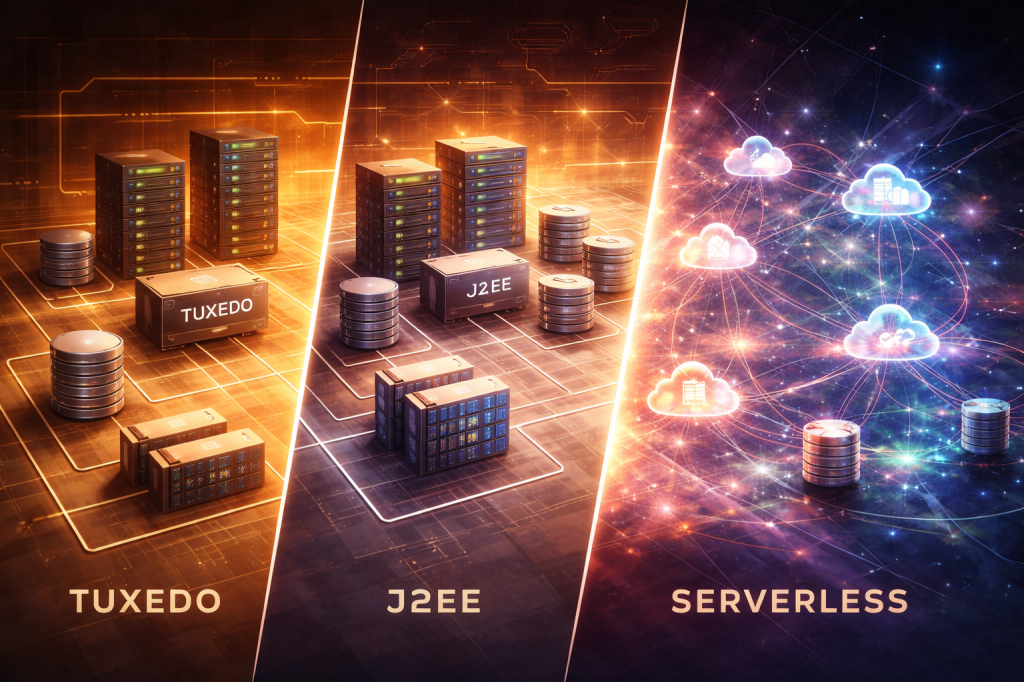
Tuxedo, J2EE, and Serverless
How My Thinking on Transaction Management Actually Evolved
I didn’t study these three eras.
I lived them.
I built real systems using:
- Tuxedo, when transactions were explicit and respected
- J2EE, when containers promised to manage complexity for us
- Serverless orchestration, where time and failure finally became first-class citizens
This is not a comparison of features.
This is a comparison of mental models — and what survived reality.
Era 1: Tuxedo — When Transactions Were Honest
When I worked with Tuxedo, I always knew where the transaction began and where it ended.
Nothing was hidden.
I explicitly:
- started the transaction
- invoked services
- committed or rolled back
There was no magic — only responsibility.
What I liked (and still respect)
- Clear transaction boundaries
- True distributed transactions
- Strong guarantees across services
- High throughput with discipline
If a transaction failed, it really failed.
If it committed, it really committed.
There was no ambiguity.
What was silently assumed
- Infrastructure was stable
- Services were under my control
- Time was short
- Failure modes were known
Tuxedo worked brilliantly because the world was small and bounded.
Era 2: J2EE — When Transactions Became Polite… and Fuzzy
Then came J2EE.
The pitch was attractive:
“Focus on business logic. The container will manage transactions.”
At first, it felt like progress.
I no longer explicitly managed transactions.
They were:
- declarative
- annotation-driven
- container-scoped
What improved
- Faster development
- Cleaner business code
- Consistent transaction demarcation
- Easier onboarding for teams
But something important changed.
What I started losing visibility into
- When exactly a transaction started
- How long it stayed open
- Which resources were enlisted
- What really happened during failure
Transactions were still there — but indirect.
And as systems grew:
- call chains became deeper
- remote calls crept into transactions
- XA participants multiplied
- recovery became operationally painful
We were still using the Tuxedo mental model, but through a thick abstraction layer.
That abstraction started leaking.
The J2EE Moment of Realisation
This is the point I distinctly remember:
I was technically “inside a transaction”, but practically outside my control.
Long-running calls.
Blocked threads.
Retries buried inside containers.
XA recovery nobody wanted to touch.
J2EE didn’t break transactions —
time did.
We were stretching a short-lived concept across long-lived business reality.
Era 3: Serverless — When Transactions Finally Let Go
Serverless forced an uncomfortable but honest question:
“What does a transaction even mean when execution is ephemeral?”
There were:
- no threads to hold
- no connections to pin
- no containers to depend on
- no illusion of control
At first, this felt like loss.
In reality, it was liberation.
The Biggest Shift: From Transaction to Workflow
Here is the clearest way I can describe my mental shift:
In Tuxedo
I managed transactions.
In J2EE
I trusted the container to manage transactions.
In Serverless
I design workflows that survive failure and time.
This is not semantics.
This is a fundamental change in how correctness is achieved.
What Replaced Transactions for Me
I no longer think in terms of:
- commit
- rollback
- XA boundaries
I now think in terms of:
- durable state
- idempotent steps
- deterministic progression
- explicit compensation
Rollback assumed nothing escaped.
Modern systems accept that things escape — and must be corrected.
That is closer to real business.
How Each Era Handled Failure (From My Experience)
Tuxedo
Failure was exceptional.
Rollback was clean.
Recovery was manual but rare.
J2EE
Failure was common.
Rollback existed, but recovery was messy.
Operations teams carried the burden.
Serverless
Failure is normal.
Retry is expected.
Recovery is built into the design.
This last part is crucial:
Serverless systems don’t fear failure — they assume it.
A Brutally Honest Comparison
| Aspect | Tuxedo | J2EE | Serverless |
|---|---|---|---|
| Transaction visibility | Explicit | Hidden | Replaced |
| Time tolerance | Low | Medium | High |
| Failure handling | Rollback | Rollback + hope | Compensation |
| Scaling model | Vertical | Clustered | Elastic |
| Operational clarity | High | Medium | High (if designed well) |
| Mental stress | Low | High | Low |
What I Trust Today (After All Three)
Today, I trust:
- idempotency over delivery guarantees
- workflow history over transaction logs
- compensation over rollback
- observability over illusion
And I no longer try to stretch transaction semantics across hours or days.
That was the biggest mistake of the middle era.
Looking Back Without Nostalgia or Regret
Tuxedo was not wrong.
J2EE was not misguided.
Serverless is not immature.
Each solved the dominant problem of its time.
But only serverless orchestration accepts time as a first-class constraint.
That acceptance changes everything.
Final Thought
If I were to summarise my journey in one line:
I stopped trying to make systems “never fail”
and started designing them to “always recover”.
That, for me, is the real evolution of transaction management.
Not less discipline.
More honesty.

 MindsWideOpen.In - AI ⚡ AI 🚀
Leave a comment