
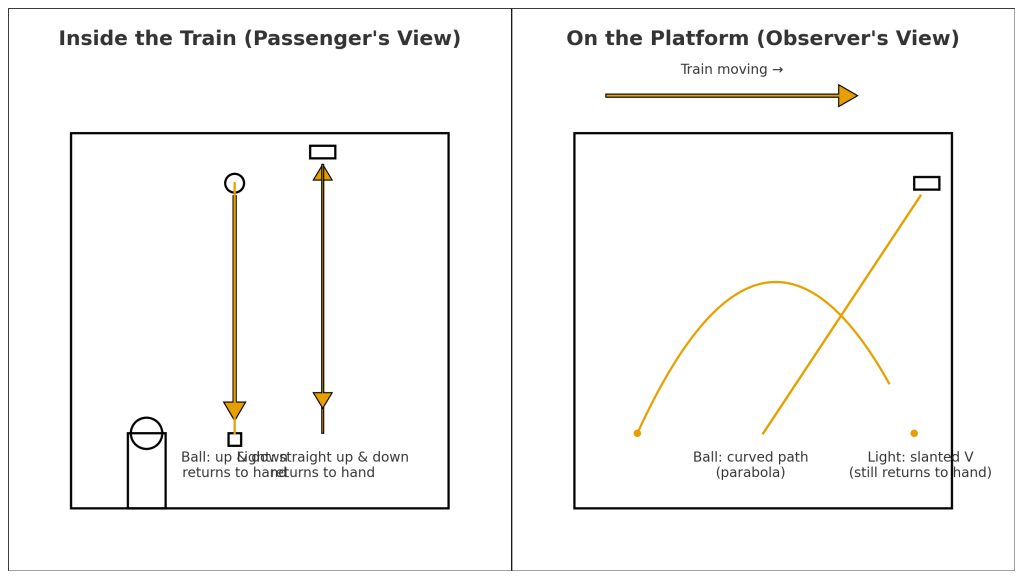
In a green coach slicing through evening light, a passenger plays two games with the universe.
First, the Ball Test. He tosses a small rubber ball straight up. From his seat it rises, hesitates, and drops neatly back into his palm. Simple. The coach, the thrower, and the ball share the same cruise. Inside this moving room, everything behaves like home.
Next, the Light Test. He flashes a beam straight up to a mirror on the ceiling. In his world, the beam goes up, kisses the mirror, and returns to the same palm. No drama. The light obeys—precisely.
But step outside to the platform and watch both experiments again.
The ball now paints a curve against the window. While it’s in the air, the coach glides forward, so the ball must arc to find the same waiting hand. Gravity sketches the curve; shared motion completes the rendezvous.
The light draws a very different story. It races in a slanted V inside the coach—up at a tilt, down at a tilt—yet still finds the same hand. Why the tilt? Because light refuses to change its pace for anyone. To protect that cosmic stubbornness, the geometry of events—space and time themselves—shuffle just enough to keep the appointment.
Two experiments. Two paths. One destination: the passenger’s palm.
Moral: Inside, the world feels normal. Outside, you see the choreography. Newton writes the ball’s dance; Einstein cues the light. Both keep time so that the universe never misses a catch.
And here’s the subtle truth — relativity touches everything, even the apple that fell on Newton’s head.
Only difference: the apple’s speed is so tiny compared to light that the effect is microscopically small — practically zero for all earthly affairs.

 MindsWideOpen.In - AI ⚡ AI 🚀
Leave a comment