
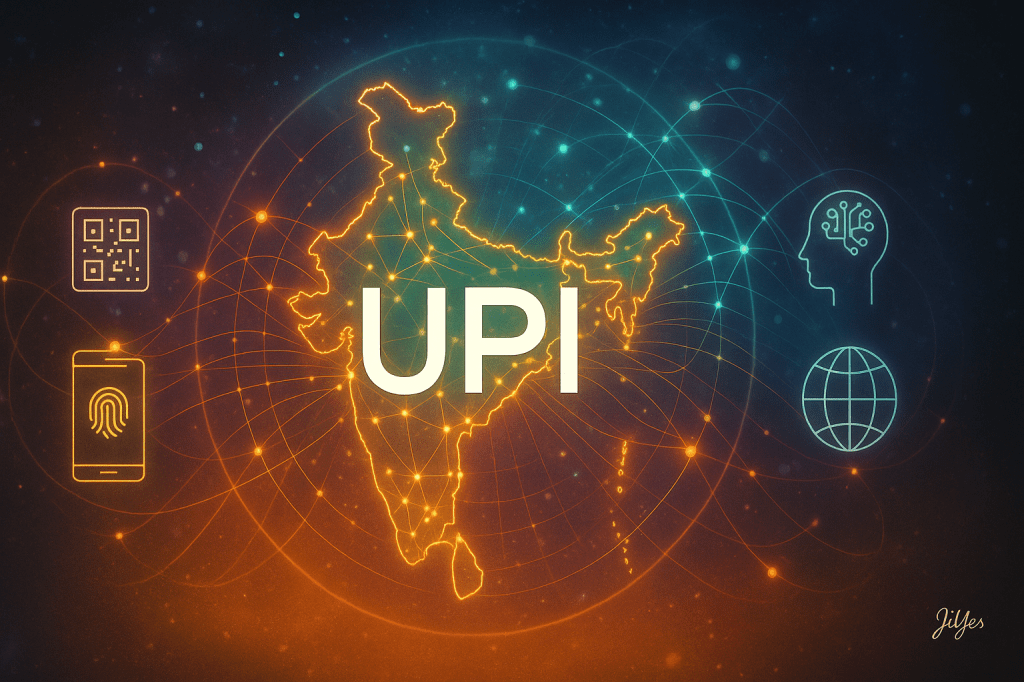
It began as a simple idea:
“What if money could move as fast as a message?”
In a world where financial systems crawled through legacy wires and batch settlements, India quietly built something audacious — a protocol so fluid, so interoperable, that it turned every phone into a bank.
That idea became UPI — Unified Payments Interface.
But beneath its simplicity lies a symphony of ten deep technologies, each borrowed, built, or reborn in India’s digital lab.
⚙️ The Ten Building Blocks of UPI
1️⃣ IMPS — The Foundation
At its core lies IMPS (Immediate Payment Service), crafted by the National Payments Corporation of India (NPCI) in 2010.
This was India’s first real-time interbank rail — the invisible highway on which UPI would later race.
2️⃣ Open Banking APIs
The next leap came from the world of RESTful APIs — first popularized by fintech platforms like Stripe and Plaid in the U.S.
NPCI took that idea and built India’s Open Banking Layer, letting apps like PhonePe, GPay, and Paytm converse directly with banks using a standard protocol.
3️⃣ Aadhaar & e-KYC — The Identity Layer
Meanwhile, UIDAI gave India something the West didn’t have — a billion verified identities.
By linking biometrics and bank accounts, e-KYC made digital onboarding and fraud control near frictionless.
4️⃣ Virtual Payment Address (VPA)
NPCI then created a masterstroke — the VPA (ganesh@axis).
It humanized money transfer. No IFSCs, no account numbers — just a name that worked like an email for money.
5️⃣ The Mobile Application Layer
Here entered Android, iOS, and a new wave of Indian developers.
Apps like BHIM, PhonePe, and GPay turned cryptographic complexity into a single thumb-tap.
This layer stitched SIM verification, device binding, and elegant UI together.
6️⃣ QR Code Revolution
Born in Japan at Denso Wave (Toyota) in 1994, the humble QR code found its destiny in India.
UPI adopted it as the universal payment language.
Every tea stall became a fintech terminal — no POS machine needed.
7️⃣ NPCI Switch & ISO 8583 Messaging
Behind the scenes, the NPCI switch speaks the ISO 8583 protocol (a Swiss-born messaging standard for cards).
That’s how 300+ banks settle in milliseconds with zero manual intervention.
8️⃣ Encryption & Tokenization
UPI’s shield is global cryptography — AES and RSA — hardened locally by CERT-In and IDRBT.
Every packet of data is sealed, transmitted, and verified end-to-end.
9️⃣ UPI 2.0 — Autopay & Mandates
In 2018, UPI learned a new trick — Autopay and e-Mandates.
Now you could subscribe, pay EMIs, or approve invoices seamlessly.
India had quietly built a recurring-payment engine for the world.
🔟 AI-Driven Fraud Analytics
Finally came the AI sentinels.
Firms like Razorpay, Juspay, and PhonePe fused machine learning with transaction telemetry, spotting fraud before it happens.
UPI became not just fast — it became aware.
🧠 JiYes Reflection — The Architecture of Democracy
UPI isn’t an app. It’s a layered protocol like TCP/IP, built from global parts and Indian philosophy —
identity, openness, security, inclusion.
It’s where Japanese QR meets American APIs meets Indian intent.
A trillion-dollar ballet of mathematics and trust.
🚀 UPI 3.0 — The Quantum Horizon
As the digital dust of UPI 2.0 settled, a new chapter opened.
India’s payments rail grew wings — reaching across borders, devices, and even into the quantum realm.
1️⃣ Cross-Border UPI — The New Silk Route of Money
UPI now speaks with Singapore’s PayNow, and soon the UAE, Nepal, Bhutan, France, and the UK.
Remittance, once a bureaucratic marathon, is now a 3-second handshake.
The chai vendor and the expat coder are suddenly on the same grid.
2️⃣ UPI Credit Line & Digital Rupee
UPI 3.0 merges payments and credit — scan a QR and choose Pay by Bank, Pay by Credit, or Pay by Digital Rupee (CBDC).
Same UX, three forms of money.
A fusion of lending, liquidity, and sovereign digital cash.
3️⃣ Voice, Vernacular & Wearables
UPI now understands India’s 22 languages — “Pay ₹200 to Rajesh” works in Tamil, Hindi, or Kannada.
Next stop: wearables and IoT.
Your wristwatch, car, or fridge could soon be a payment node.
4️⃣ Quantum-Safe Encryption
As quantum computers threaten classical cryptography, India’s research labs are testing quantum-resistant keys for UPI.
The irony: quantum physics, once feared for breaking encryption, is now protecting it.
5️⃣ AI Trust Layer
Billions of transactions train deep models that anticipate anomalies before they occur.
Fraud detection evolves into a neural immune system — self-learning, self-healing.
6️⃣ Bharat Stack — The Grand Integration
Behind it all runs Bharat Stack:
- Aadhaar for identity
- UPI for payments
- ONDC for commerce
- DigiLocker for documents
- Account Aggregator for data flow
Together, they form the nervous system of a self-aware digital nation.
7️⃣ Global Ripple Effect
More than 30 nations now study UPI’s design.
For the first time, India exports not code, but architecture — the design of digital trust.
Visa and Mastercard look less like rivals, more like relics of a pre-API age.
🌕 JiYes Closing Thought — From Unified Payments to Unified Purpose
UPI began as a way to move money faster.
But it became something greater — a moral algorithm that democratized access, erased hierarchies, and redefined inclusion.
From the street vendor in Madurai to the data scientist in Seattle, everyone now participates in the same digital rhythm.
The next frontier isn’t just faster payments — it’s frictionless trust.
A world where currency, code, and conscience are one.

 MindsWideOpen.In - AI ⚡ AI 🚀
Leave a comment