
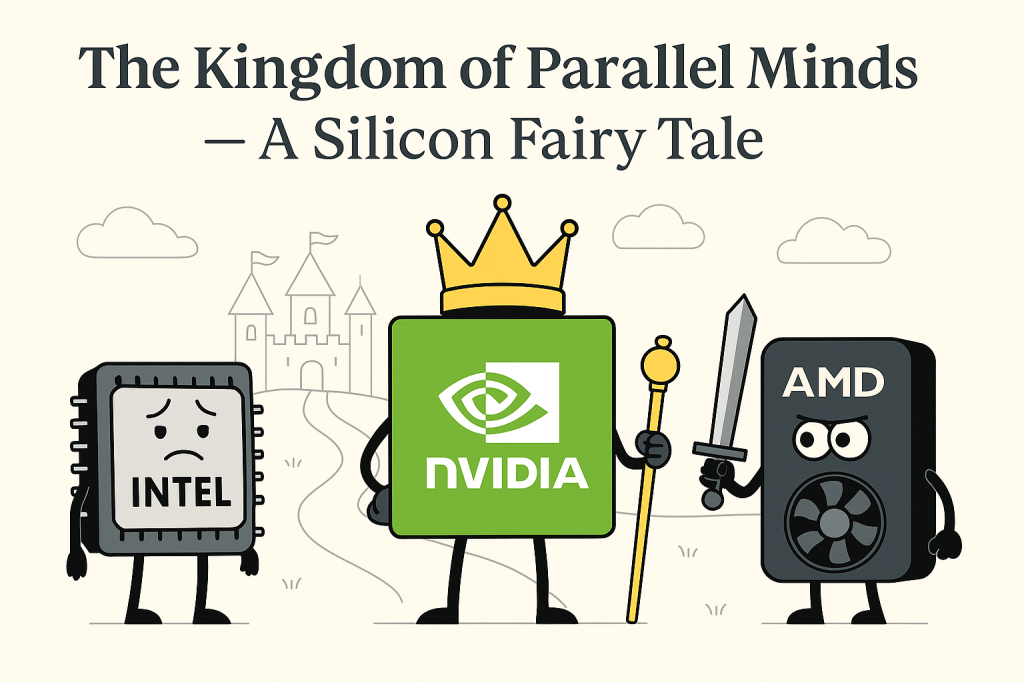
Once upon a silicon time, in the vast realm of transistors and thought, there lived two mighty rulers. Intel, the Emperor of Sequential Logic, reigned supreme over the land of Central Processing. His empire was vast — every device bore his seal, every byte moved to his rhythm.
And then there was NVIDIA, a quiet artist in a corner workshop, known mostly for painting pixels and conjuring landscapes for gamers. While Intel’s world ran on strict order — one instruction at a time — NVIDIA dreamed of chaos that could be organized, of many minds thinking together.
Years rolled by. Intel grew richer, smaller, faster — yet still linear. NVIDIA, meanwhile, began teaching its tiny workers inside chips to think in parallel. It forged a new spell called CUDA, a secret language that let scientists, artists, and dreamers talk directly to its creations.
The kingdom laughed. “Who needs so many little thinkers when one big one rules perfectly?” they asked. NVIDIA simply smiled.
Then came the storm. The world discovered Artificial Intelligence — a kind of thinking that needed thousands of simultaneous voices, not one commanding mind. The old emperor’s armies stumbled; their single-threaded swords could not match the swarm. NVIDIA’s legions, long trained for parallel battle, rose like lightning.
Suddenly, the humble painter of pixels became the architect of intelligence. His creations — Hopper, then Blackwell — became the beating hearts of every data citadel. The night sky of datacenters glowed with green light, powered by NVIDIA’s dream of parallel minds.
Intel, once the unchallenged sovereign, looked out from his high tower and realized the future had quietly changed direction. His dominion of sequence was giving way to a republic of simultaneity. In a gesture rare for kings, he extended his hand to his rival. Together, they began to build new hybrids — CPUs fused with GPUs, brains that blended old order and new imagination.
Others soon joined the great race — AMD, startups, and silicon rebels, each trying to decode the new language of intelligence. But NVIDIA’s spell ran deeper. It had bound not just transistors, but the trust of developers, the loyalty of coders, and the faith of creators. It had turned a chip into a culture.
In truth, NVIDIA had never been fighting Intel. It had been fighting time — reading the matrix of history, predicting the next eigenvector of evolution. Where Intel optimized the present, NVIDIA optimized the future.
And so, in this ever-evolving kingdom of computation, Intel still stands — proud, older, and wiser — while NVIDIA’s green banners flutter across the data clouds, declaring that imagination, not instruction, rules the world now.
For in this fairy tale of silicon and code, the moral is simple yet profound:
Those who learn to think in parallel will always lead those who think in sequence.
And somewhere, beneath his trademark leather jacket, Jensen Huang smiles — the alchemist who turned graphics into consciousness and made the kingdom of parallel minds real.

 MindsWideOpen.In - AI ⚡ AI 🚀
Leave a comment