
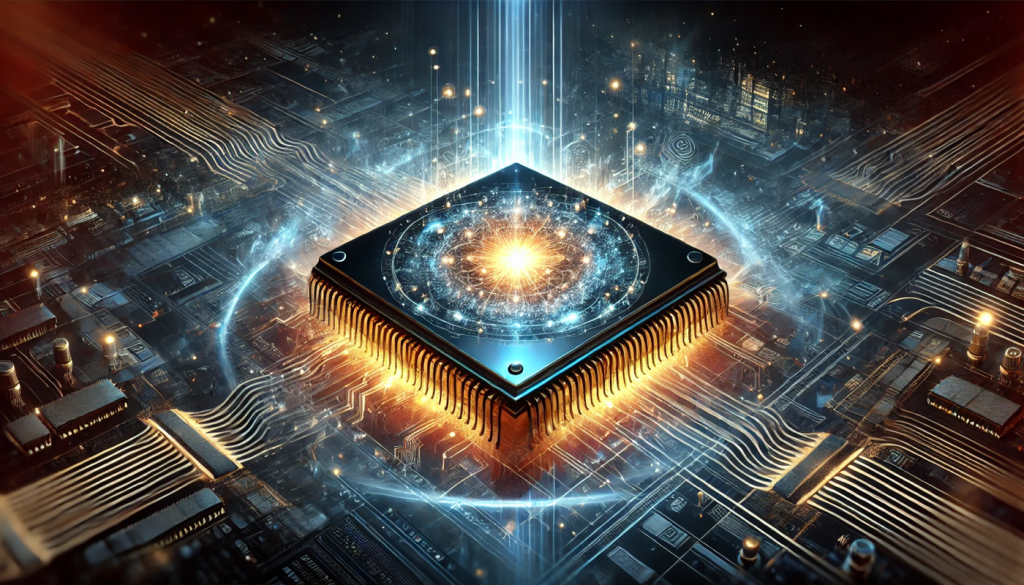
For centuries, we have known three common states of matter—solid, liquid, and gas. But what if there was a fourth state that could revolutionize the way we think about materials, electricity, and even computing? Welcome to the world of Topological States and Majorana Superconductors, where electrons move in ways we never thought possible, unlocking a future of ultra-fast computing and energy-efficient technology.
Understanding Different States of Matter & The Topological State
Imagine you have four different types of materials in front of you: a rock (solid), a glass of water (liquid), a balloon full of air (gas), and a special quantum material (topological state). Let’s compare them in simple terms:
1. Structure (How They Hold Their Shape)
- Solid (Rock): A solid has a fixed shape and doesn’t change unless you break it.
- Liquid (Water): A liquid takes the shape of its container but doesn’t hold its own shape.
- Gas (Air in Balloon): A gas spreads out in all directions and has no fixed shape.
- Topological State (Quantum Material): It might look like a solid, but its electrons move only along the edges or surfaces, like invisible highways.
2. Particle Motion (How Things Move Inside)
- Solid: Atoms are tightly packed and only vibrate in place (like a crowded train).
- Liquid: Atoms move more freely but stay close together (like swimmers in a pool).
- Gas: Atoms are far apart and move randomly in all directions (like people running around in a park).
- Topological State: Electrons inside move only along the surface in a special protected way, without losing energy.
3. Energy Efficiency (How Well It Conducts Electricity)
- Solid (Metals like Copper): Conducts electricity, but some energy is lost as heat (like a light bulb getting hot).
- Liquid (Some Ionic Liquids): Can conduct electricity but not very efficiently (like saltwater allowing some charge to pass).
- Gas (Air): Very poor conductor of electricity (that’s why air acts as an insulator).
- Topological State: Electrons flow without resistance, meaning no energy is wasted, making it super efficient.
4. Response to Deformation (What Happens When You Try to Change Its Shape?)
- Solid: Breaks or cracks if you hit it too hard (like dropping a glass).
- Liquid: Changes shape easily but remains together (like pouring water).
- Gas: Expands or compresses when pushed (like squeezing a balloon).
- Topological State: Remains unchanged even if there are defects or impurities, making it very reliable.
5. Examples (Where You Can Find Them)
- Solid: Metals, ice, wood (used in buildings, tools, and everyday objects).
- Liquid: Water, mercury (used in drinking, thermometers, and cooling systems).
- Gas: Air, helium, oxygen (used for breathing, balloons, and fuel combustion).
- Topological State: Topological insulators, Majorana superconductors (used in cutting-edge technologies like quantum computing and future energy-efficient electronics).
What is the Topological State?
Imagine a highway where cars (electrons) can move without traffic, roadblocks, or speed limits—that’s how electrons behave in a Topological State. Unlike regular materials where electrons scatter and lose energy, topological materials allow electrons to travel along protected pathways, ensuring zero energy loss. These materials remain stable even when bent, stretched, or exposed to imperfections, making them incredibly reliable.
What are Majorana Superconductors?
Superconductors are materials where electricity flows without energy loss. Now, imagine a superconducting material that also follows topological principles—this is a Majorana Superconductor. It allows electrons to move in a stable, error-proof way, making it the perfect candidate for quantum computing.
A key feature of Majorana Superconductors is the presence of Majorana fermions—exotic quantum particles that behave as their own antiparticles. These fermions create an ultra-stable system that can store and process quantum information without errors.
Why Should You Care?
Topological materials and Majorana Superconductors have the potential to:
✅ Revolutionize computing – Faster, error-proof quantum computers.
✅ Save energy – Zero energy loss in electronics and data centers.
✅ Enhance cybersecurity – Unbreakable quantum encryption.
✅ Enable futuristic devices – Ultra-efficient AI and next-gen semiconductors.
The discovery of Topological States is as big as the invention of semiconductors, and we are only scratching the surface of what’s possible. This could be the foundation for quantum internet, AI breakthroughs, and new materials that defy physics as we know it.
The Future is Here
We are on the brink of a quantum revolution. Scientists and engineers are now racing to harness the power of Topological States and Majorana Superconductors to build the most advanced computing systems ever imagined. The next generation of technology will be smarter, faster, and infinitely more efficient, and it all starts here.
Are you ready for the future? 🚀
 MindsWideOpen.In - AI ⚡ AI 🚀
Leave a comment