
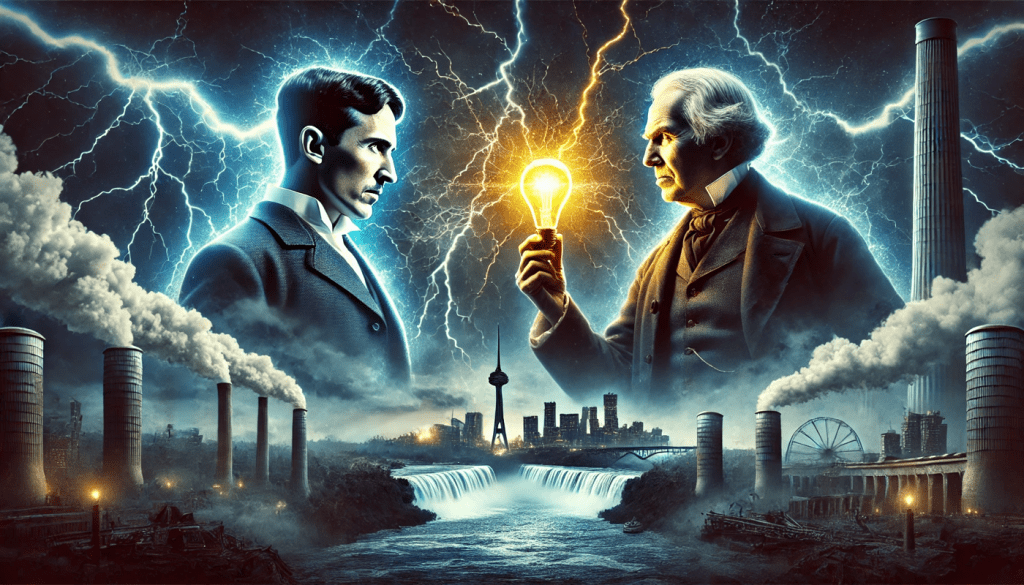
Introduction: Beyond the Roaring Falls, a Storm Was Brewing
Power. It has always been the ultimate currency—not just in politics or business, but in the very fabric of civilization itself. The late 19th century was a time when the world stood at a tipping point, teetering between darkness and illumination, between an era of gas lamps and a future where entire cities could be powered at the flick of a switch.
But this revolution was not merely about scientific progress—it was a battle of power games, deception, and manipulation, fought between two extraordinary men:
• Thomas Edison, a ruthless businessman who wielded the media like a weapon, determined to maintain his empire of Direct Current (DC) at any cost.
• Nikola Tesla, the eccentric genius who envisioned a world powered by Alternating Current (AC), a system far superior, yet violently opposed.
The War of Currents was not just about electricity—it was about who would control the future. It was a war fought with propaganda, financial sabotage, public fear campaigns, and brutal smear tactics. It was a conflict that saw false narratives overpower truth, where science had to battle against vested interests, where real intelligence (RI) was buried under the weight of artificial misinformation.
And at the center of it all, beyond the roaring waters of Niagara Falls, the ultimate test of truth awaited. If Tesla’s AC could tame the power of nature itself, he would win not just a scientific battle, but a war that would redefine human civilization.
This is the story of the War of Currents, a tale of brilliance, betrayal, and an electric battle where only one current could power the future.
Chapter 1: The Challenger Arrives
New York, 1884. The city is a storm of progress, a landscape filled with the hum of innovation, where industry thrives, and ambitions clash. Among the thousands of immigrants stepping onto its shores, one man stands apart—tall, with piercing blue eyes and a restless mind racing ahead of his time.
Nikola Tesla arrives in America with nothing but a letter and a dream.
The letter, written by his former employer, Charles Batchelor, is addressed to Thomas Edison, the most powerful inventor in the world. It reads:
“I know two great men. One is you. The other is this young man.”
Tesla believes Edison is the key to unlocking the future of electricity. But Edison is not a man easily impressed. Tesla is put to work improving Edison’s Direct Current (DC) generators—the very system Tesla already knows is flawed.
For months, Tesla toils relentlessly, designing solutions that vastly improve Edison’s inefficient generators. He does this under a verbal promise from Edison—a reward of $50,000 if he succeeds.
And Tesla does succeed.
But when he finally approaches Edison for his payment, Edison laughs.
“You don’t understand our American humor,” he sneers.
Tesla is shattered. He resigns immediately, walking away from Edison’s empire, penniless but fueled by an unshakable belief that AC will one day replace DC.
The war has begun.
Chapter 2: The War of Currents Ignites
Tesla’s genius does not go unnoticed for long. He soon finds a powerful ally—George Westinghouse, an industrialist and engineer who believes in Tesla’s vision for Alternating Current (AC).
AC has clear advantages over DC:
• It can travel long distances with minimal loss.
• It can be stepped up or down in voltage using transformers, making it more efficient and scalable.
• It enables the use of induction motors, Tesla’s revolutionary design that eliminates the need for mechanical commutators.
Tesla and Westinghouse begin rolling out AC-powered streetlights and systems in various cities, posing a direct threat to Edison’s DC monopoly.
Edison retaliates.
He unleashes a campaign of fear and misinformation, branding AC as dangerous and deadly. He begins a gruesome public relations stunt—electrocuting animals using AC in front of horrified crowds, claiming it is a “killer current.”
To cement this image, Edison supports the development of the electric chair, ensuring that it is powered by AC. He wants AC to be associated with death, not progress.
But science cannot be buried forever. Tesla and Westinghouse continue pushing forward, and soon, a historic showdown looms on the horizon—one that will determine the fate of electricity itself.
Chapter 3: The Battle of Niagara Falls
The year is 1893, and the stage is set.
Westinghouse and Tesla win the contract to power the Chicago World’s Fair, the first large-scale demonstration of AC technology. Edison and his supporters try everything to stop them, but they fail.
As night falls, hundreds of thousands of electric bulbs flicker to life, illuminating the fairgrounds with an ethereal glow. The world sees the future—and it is powered by Tesla’s AC.
But the final test is still to come.
The Niagara Falls Power Project is the largest electrical undertaking in history. If Tesla’s system can successfully harness the raw, untamed energy of the falls and send power across vast distances, it will prove beyond doubt that AC is the superior system.
Westinghouse is hesitant. The financial war against Edison’s supporters has nearly crippled his company. But Tesla, driven not by money but by the pursuit of progress, makes a decision that shocks even Westinghouse—
He tears up his royalty contract, forfeiting millions, just to ensure AC’s victory.
In 1896, Niagara Falls roars to life.
AC power flows across miles of transmission lines, lighting up Buffalo, New York, proving once and for all that Tesla’s system is the future of electricity.
The war is over.
Edison’s DC system collapses, and within a few years, even his own company (General Electric) is forced to adopt AC technology.
Tesla has won.
Chapter 4: The Fall of a Genius
Tesla should have been celebrated as the father of modern electricity, but fate is not always kind to visionaries.
While Edison dies wealthy, a celebrated businessman, Tesla spends his later years in solitude and poverty. His dreams grow bigger, wilder—wireless energy transmission, radio waves, remote-controlled machines, ideas too advanced for his time.
Without funding, many of his projects remain unfinished, and his genius is slowly forgotten by the world.
On January 7, 1943, Tesla dies alone in a New York hotel room, his mind still filled with ideas that the world would take a century to catch up to.
But time has a way of correcting its mistakes.
Epilogue: The Legacy of a Titan
Today, every power grid on Earth operates on Tesla’s AC system. His name, once nearly erased from history, is now synonymous with innovation, vision, and scientific brilliance.
Meanwhile, Edison’s once-mighty DC empire has faded into irrelevance.
The War of Currents was not just about electricity. It was about the struggle between vision and control, innovation and suppression, truth and deception.
And in that war, Tesla won.
The world just took its time realizing it.

 MindsWideOpen.In - AI ⚡ AI 🚀
Leave a comment