
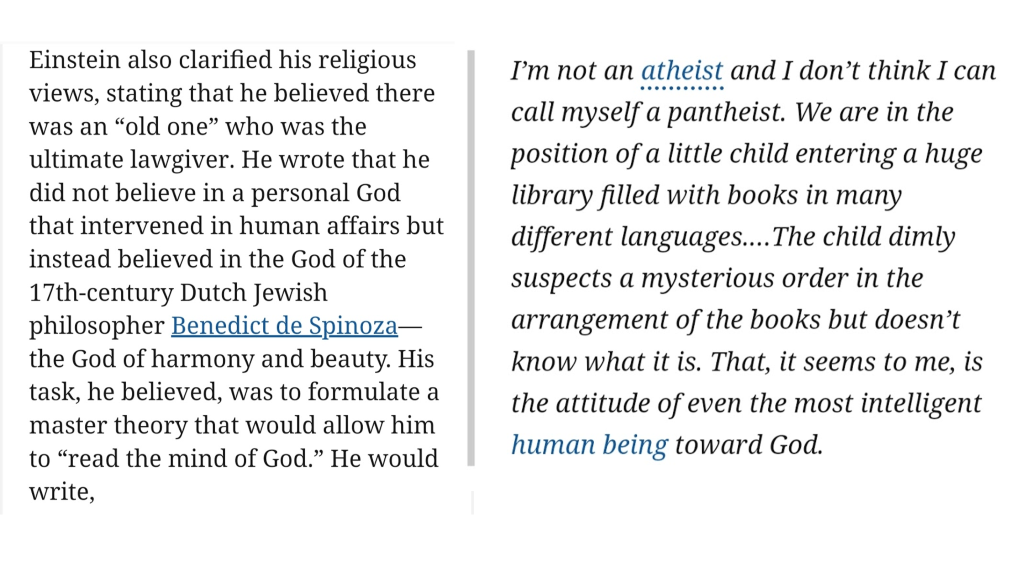
Albert Einstein’s views on God have always struck a chord with me. His idea of the “old one,” a cosmic lawgiver representing harmony and beauty, aligns with the awe I’ve always felt toward the universe. He rejected the notion of a personal God who intervenes in human affairs, instead embracing Spinoza’s God—a force that manifests in the elegance of natural laws.
I find his analogy of a child stepping into a vast library particularly moving. Imagine standing amidst endless shelves of books, each written in an unknown language. The child senses a mysterious order but cannot yet decipher it. That is how Einstein described humanity’s relationship with the universe. And frankly, that’s how I feel too.
Science as a Spiritual Calling
Einstein’s vision of science as a way to “read the mind of God” has deeply influenced how I view the world. For him, understanding the universe wasn’t just an academic exercise—it was almost spiritual. The idea that everything, from the smallest particle to the grandest galaxy, is governed by laws waiting to be uncovered resonates with my fascination for physics and mathematics.
Growing up, my grandfather, a brilliant self-taught engineer, would often introduce me to books by Yakov Perelman. He made complex ideas seem simple and beautiful. To me, science has always been a blend of logic and reverence. Like Einstein, I’ve often felt that uncovering even a fraction of these laws is an act of devotion.
The God of Harmony
Einstein’s rejection of a personal God wasn’t a rejection of divinity itself—it was an affirmation of a deeper connection with the universe. I see this as liberating, even profound. He didn’t look for miracles or divine interventions but instead saw the sacred in the way the universe works.
For me, this echoes the Bhagavad Gita, where Krishna speaks of being the essence of all laws and order. While Einstein may not have consciously drawn from such texts, the parallels are unmistakable. Both perspectives challenge us to see divinity not in anthropomorphic terms but in the profound harmony that governs existence.
A Reminder of Humility
Einstein’s metaphor of the child in the library is a humbling reminder of how little we know. As someone who enjoys diving into complex topics like quantum mechanics or relativity, it’s easy to get carried away with what I think I’ve understood. But this perspective keeps me grounded.
No matter how much we learn, the mysteries will always outnumber the certainties. For me, this isn’t frustrating—it’s exhilarating. It keeps the wonder alive, the drive to explore intact. And isn’t that the essence of both science and spirituality?
The Bridge Between Logic and Faith
Einstein’s views also remind me of the countless debates I’ve had with friends and family. Can science and spirituality coexist? Are they irreconcilable opposites? Einstein’s approach makes it clear—they’re two sides of the same coin. The search for truth, whether through a telescope or a scripture, is rooted in the same desire: to understand the why and how of our existence.
This is why I resonate with his famous line: “I want to know how God created this world. I am not interested in this or that phenomenon. I want to know His thoughts; the rest are details.” This profound curiosity is a reminder that life isn’t about definitive answers but about the joy of asking the right questions.
My Takeaway
We’re all children in this infinite library of existence. Whether we decipher one book or glimpse an overarching order, the act of seeking is what matters. Einstein’s humility, his reverence for what he couldn’t understand, and his joy in uncovering what he could are lessons I carry with me.
For me, this journey isn’t just about understanding—it’s about living. Whether through science, philosophy, or personal growth, the quest to “read the mind of God” feels like the ultimate purpose. After all, as Einstein believed, the universe isn’t just a set of facts to be studied. It’s a masterpiece to be experienced.
And I, for one, am grateful to be part of that experience.

 MindsWideOpen.In - AI ⚡ AI 🚀
Leave a comment