
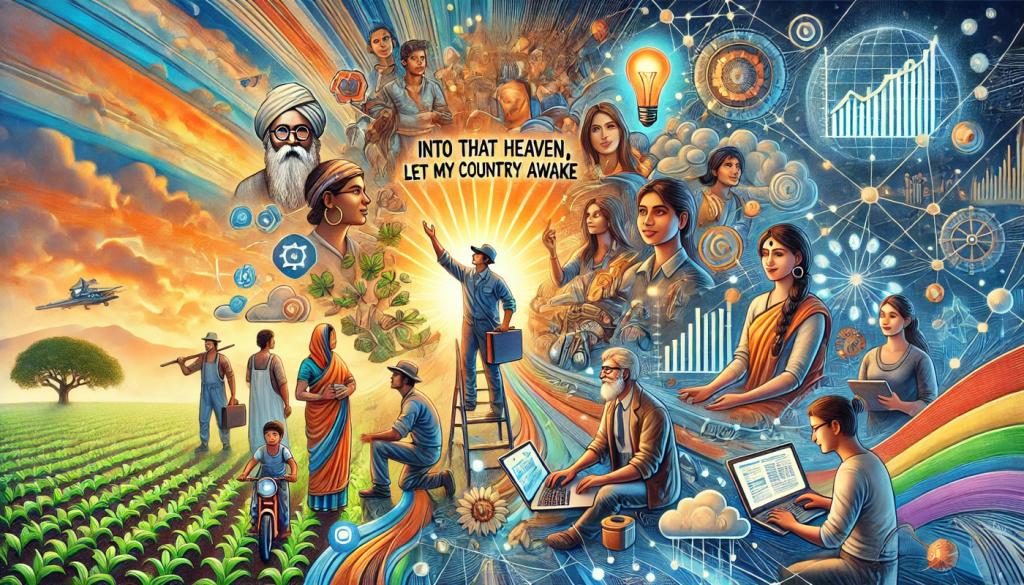
Rabindranath Tagore’s timeless words are a call for progress. They say, “Where the mind is without fear and the head is held high.” They inspire us to imagine a future where boundaries dissolve. Opportunities abound. Everyone has the freedom to define their own path. In this rapidly evolving world, fueled by technological advancements and shifting societal values, India must adapt. It’s time to redefine roles and skillsets, embracing a forward-thinking framework that promotes innovation, inclusivity, and sustainable growth.
1. Why Redefine Legacy Classifications?
The Varna system, in its origin, aimed to categorize individuals based on their qualities and contributions to society. However, over centuries, it devolved into rigid, birth-based divisions that stifled personal potential and opportunity. In today’s dynamic, tech-driven world, these historical structures are no longer relevant. They restrict progress and prevent the celebration of merit and adaptability.
We shouldn’t hold onto antiquated classifications. We must recognize the urgent need to create a system. This new system should align with our contemporary realities. The path forward demands a break from legacy constructs, offering a fresh lens to evaluate talent, potential, and achievement.
2. The Case for a New Skills Taxonomy
As the 21st century redefines work and society, the skills we value and cultivate must also evolve. A modern skills taxonomy reflects the realities of today’s interconnected, rapidly changing world.
• Technology and Innovation: From AI to global connectivity, modern professions demand constant learning and adaptation.
• Meritocracy Over Ancestry: Success today is shaped by creativity, skills, and problem-solving—not lineage or circumstance.
• Global Relevance: The rise of remote work and the emergence of global markets have created opportunities. These roles were unimaginable a few decades ago.
India stands at the intersection of technological transformation and societal change. To thrive in this era, we must shed outdated societal structures like Varna. We need to replace them with a flexible, skills-driven framework. This is not just reform; it’s a revolution.
We embrace this transformation. In doing so, we align with Tagore’s vision of a “heaven of freedom”. It is a nation where “knowledge is free” and “the clear stream of reason has not lost its way.”
Let’s explore how:
• A. Traditional roles are evolving.
• B. Professions are being disrupted.
• C. New ones are emerging.
Together, these shifts drive us toward an inclusive, skills-driven India that celebrates merit. They foster creativity and honor Tagore’s dream of a fearless, awakened society.
3. How Traditional Roles Have Evolved
For centuries, societal roles in India were defined by rigid structures, often limiting individuals based on birth or lineage. However, technology, globalization, and modern values have blurred these boundaries, enabling people to transcend their historical identities.
3.1. Farmers: Tech-Driven Cultivators
Farming has transitioned from manual labor to precision agriculture, where technology plays a pivotal role. Today’s farmers use drones, IoT sensors, and AI analytics to optimize yields, reduce waste, and practice sustainability.
• Transformation: Farmers now analyze soil health, predict weather patterns, and implement precision watering systems through smart devices.
• Example: Rajesh, a farmer in Maharashtra, employs IoT-based irrigation systems, saving 50% water and boosting his crop yields. He’s also diversifying into agri-tourism, hosting workshops for urban dwellers to reconnect with nature.
3.2. Traders: Global Entrepreneurs
E-commerce platforms like Amazon, Flipkart, and Meesho have empowered traders to reach global markets, transforming local businesses into international ventures.
• Transformation: Traders leverage analytics to understand customer preferences, adapt to trends, and streamline supply chains.
• Example: Priya, a textile seller in Tamil Nadu, uses Instagram and Etsy to showcase her products globally, turning her small-town business into an international brand.
3.3. Warriors: Defenders of the New Frontier
The concept of a warrior has expanded beyond physical combat to include cybersecurity experts, drone operators, and intellectual strategists. Modern defense requires both technical and analytical skills.
• Transformation: Warriors now safeguard digital infrastructures, manage drone fleets, and design strategies for hybrid warfare.
• Example: Aarav, a cybersecurity specialist, protects critical government data from ransomware attacks, exemplifying how modern warriors defend nations in cyberspace.
3.4. Knowledge Keepers: Digital Gurus
The role of priests and spiritual guides has evolved in the digital age. Online platforms allow them to connect with global audiences, blending traditional wisdom with modern outreach.
• Transformation: Rituals, teachings, and spiritual counseling are now available through livestreams and apps, making spirituality more accessible.
• Example: Swami Prakash is a priest in Varanasi. He conducts online pujas for NRIs. He uses YouTube to teach Vedic chanting to global audiences.
As Tagore wrote, “Where the world has not been broken up into fragments by narrow domestic walls.” Technology and innovation are enabling individuals to transcend historical boundaries. This creates a world where roles are defined by merit and adaptability.
4. How Professions are being disrupted?
While technology has expanded opportunities, it has also disrupted existing professions, demanding that individuals continuously learn and adapt.
4.1. Drivers: Navigators of the New Mobility
Autonomous vehicles, ride-hailing apps like Ola and Uber, and logistics platforms have reshaped transportation. Drivers now transition into fleet management, logistics, or maintenance roles.
• Example: Ravi is a former cab driver. Now, he supervises a fleet of electric delivery vans. He manages routes and efficiency through AI-powered logistics software.
4.2. Teachers: Facilitators of Lifelong Learning
Ed-tech platforms like Byju’s, Khan Academy, and Coursera have revolutionized education, empowering teachers to deliver personalized and accessible learning experiences.
• Example: Meera is a history teacher. She uses AR to create immersive lessons on ancient civilizations. This approach engages students worldwide from her small-town school.
4.3. Healthcare Workers: Tech-Integrated Caregivers
AI diagnostics, robotic surgeries, and telemedicine have transformed healthcare, requiring doctors, nurses, and technicians to integrate technology into their practices.
• Example: Fatima, a nurse, upskilled to operate robotic surgical assistants. This enabled precision in surgeries. She became an integral part of a cutting-edge hospital.
Tagore’s vision of a land “where tireless striving stretches its arms towards perfection” underscores the ongoing need for professionals. They must embrace lifelong learning. Professionals should also adapt to technological advancements.
5. How New Professions are emerging?
The digital age has given rise to careers that didn’t exist a decade ago. These careers offer new opportunities for creativity. They also provide flexibility and innovation.
5.1. Content Creators: Digital Storytellers
Platforms like YouTube, TikTok, and Instagram have turned individuals into influencers and creators, offering careers in entertainment, education, and advocacy.
• Example: Kavita, a homemaker, became a food vlogger. She shares traditional recipes with a global audience. She earns a steady income through sponsorships.
5.2. Gig Economy Workers: Flexible Achievers
Freelance platforms and remote work opportunities have created a thriving gig economy, where individuals work on-demand in diverse fields.
• Example: Arjun, a freelance graphic designer, collaborates with international clients, earning in multiple currencies while working from his village.
5.3. AI Developers and Data Scientists: Architects of the Future
AI and data science are at the forefront of technological innovation, creating roles that combine technical expertise with ethical considerations.
• Example: Riya, an AI developer, creates algorithms for precision medicine, revolutionizing healthcare delivery in rural areas.
As Tagore envisioned, “Where the clear stream of reason has not lost its way.” The focus shifts from lineage to skills and contributions. This shift enables individuals to craft their destinies in a rapidly changing world.
6. Reimagining a Skills-Driven India
In this transformative era, skills—not heritage—define success. This redefinition aligns with Tagore’s dream of an India “where knowledge is free” and “the mind is without fear.”
Real-Life Examples of Transformation
• Anjali, born into a family of weavers, leverages online platforms to become a textile designer, selling her creations globally.
• Rahul, a former truck driver, transitions to logistics management, mastering analytics through online courses.
• Fatima, trained as a nurse, upskills to work with robotic surgical systems, contributing to cutting-edge healthcare solutions.
• Mohammed, a small trader, expands his business through e-commerce, shipping products across continents.
• Pooja, a teacher, uses ed-tech tools to mentor students from diverse backgrounds, enabling them to excel in STEM fields.
7. Building the New Skills Taxonomy
The new taxonomy must emphasize:
1. Merit and Adaptability: Roles are determined by skills and learning, not heritage.
2. Lifelong Learning: With industries evolving, continuous skilling ensures individuals stay relevant.
3. Respect for Every Role: From drone operators to community workers, every contribution matters.
8. Future Worth Dreaming Of
“Where words come out from the depth of truth.”
Tagore’s poem reminds us of our shared aspiration for an inclusive, enlightened society. Let us strive to build a nation where:
• Opportunities are free from fear and prejudice.
• Knowledge flows without barriers.
• Creativity defines progress.
The dream of “a heaven of freedom” is not distant. It is achievable through collective will and transformative action.
9. Conclusion: Into That Heaven of Freedom
“Into that heaven of freedom, my Father, let my country awake.”
Let us awaken to an India where technology bridges gaps. Let skills define identity. In this India, every individual finds their place in a society unshackled by the past. Together, we can make this dream a reality.
We envision an India where minds are wide open to the infinite possibilities of the future.
Are you ready to awaken to this vision?
APPENDIX A
Skills Taxonomy Framework Template
The purpose is to establish a structured, context-specific, and evolving skills taxonomy framework. It must reflect current realities and anticipate future trends. It should also foster a culture of lifelong learning, adaptability, and inclusivity.
A1. Foundational Structure of the Skills Taxonomy
A1.1 Skill Categories
Define broad categories based on societal and economic demands:
A111. Core Skills: Essential skills applicable across all domains.
• Digital Literacy: Proficiency in technology and online tools.
• Communication: Written, verbal, and digital communication skills.
• Critical Thinking: Problem-solving, analytical reasoning, and decision-making.
• Adaptability: Ability to learn, unlearn, and relearn in dynamic environments.
A112. Functional Skills: Specific skills required for particular industries or roles.
• Technical: Programming, engineering, data analysis, cybersecurity.
• Creative: Design, content creation, storytelling, artistic innovation.
• Managerial: Project management, strategic planning, team leadership.
A113. Future-Oriented Skills: Emerging areas vital for evolving industries.
• AI and Machine Learning
• Sustainability and Green Technologies
• Blockchain and Decentralized Systems
• Ethics in Technology
A114. Interpersonal and Emotional Skills: Skills enhancing collaboration and personal growth.
• Emotional Intelligence
• Teamwork and Collaboration
• Conflict Resolution
A1.2 Levels of Proficiency
Establish clear proficiency levels:
A121. Beginner: Basic understanding, capable of following instructions.
A122. Intermediate: Independent worker with practical application experience.
A123. Advanced: Deep expertise, capable of leading projects and mentoring others.
A124. Expert: Innovator and thought leader in the field.
A2. Customization by Context
A2.1 Industry-Specific Modules
Define skills by industry to ensure relevance.
Example: Healthcare
• Core: Communication, empathy, digital literacy.
• Functional: Robotic surgery, telemedicine, patient data analysis.
• Future-Oriented: AI diagnostics, genomic medicine, health-tech entrepreneurship.
Example: Agriculture
• Core: Basic finance, technology use, adaptability.
• Functional: Precision farming, irrigation management, pest control.
• Future-Oriented: Agri-tech innovation, sustainability practices, carbon farming.
A2.2 Regional Adaptations
Tailor skills to local contexts, addressing cultural, technological, and economic factors.
3. Dynamic Framework for Lifelong Learning
3.1 Skill Evolution Pathways
Enable individuals to progress through interconnected pathways.
Example Pathway: Technology
1. Digital Literacy → Data Analytics → AI Development → Ethical AI Governance.
Example Pathway: Education
1. Classroom Management → Ed-Tech Integration → Personalized Learning Design → Global Education Policy Development.
A3.2 Certification and Validation
Create standardized methods for recognizing and validating skills.
• Digital badges and micro-credentials.
• Recognized certifications (e.g., AWS, Google, Microsoft).
• Peer-reviewed portfolios and assessments.
A4. Deployment Strategies
A4.1 Technology Integration
Leverage platforms for scaling access to skill-building resources.
• Learning Platforms: Coursera, Khan Academy, Byju’s.
• Skill Analytics: AI-driven assessments and progress tracking.
A4.2 Institutional Partnerships
Collaborate with educational institutions, industry leaders, and government bodies for curriculum design and implementation.
4.3 Community Engagement
Build awareness campaigns to highlight the importance of skill adaptability and inclusivity.
A5. Metrics for Success
A5.1 Skill Adoption and Utilization
• Percentage of the workforce engaged in reskilling/upskilling programs.
• Number of certifications attained per year.
A5.2 Career Outcomes
• Improved employment rates in emerging industries.
• Growth in entrepreneurial ventures aligned with future trends.
5.3 Equity and Accessibility
• Reduction in skill gaps across socio-economic and regional divides.
• Increased participation of underrepresented groups in advanced roles.
This skills taxonomy framework provides a practical, future-ready approach to redefine individual capabilities. It empowers individuals to thrive in evolving professions. It also aligns society with the vision of inclusion, innovation, and progress. This vision is articulated by Tagore in his dream of a fearless and awakened nation.
Appendix B
Real-Life Examples for Skills Taxonomy Framework
This appendix provides practical examples. These examples showcase the application of the skills taxonomy framework across various domains. They illustrate how individuals and industries adapt to evolving demands.
B1. Core Skills Examples
B1.1. Digital Literacy
• Example: Rural farmers in India use mobile apps like Kisan Suvidha. They access weather forecasts, market prices, and expert advice through these apps.
• Example: Artisans adopting platforms like Etsy to sell handcrafted products globally.
B1.2. Communication
• Example: A healthcare professional using telemedicine platforms like Practo to consult with patients and explain complex medical terms clearly.
• Example: An NGO worker effectively campaigning for environmental issues via social media storytelling.
B1.3. Critical Thinking
• Example: Data analysts identifying fraudulent activities by recognizing unusual patterns in financial transactions using AI tools.
• Example: Urban planners rethinking transportation in congested cities using simulations to improve traffic flow.
B1.4. Adaptability
• Example: Teachers pivoting to online teaching during COVID-19, mastering tools like Zoom, Google Meet, and interactive whiteboards.
• Example: Small business owners shifting to e-commerce platforms to sustain operations during lockdowns.
B2. Functional Skills Examples
B2.1. Technical Skills
• Example: Engineers using CAD (Computer-Aided Design) software to create prototypes for renewable energy systems.
• Example: Coders developing apps like Aarogya Setu for contact tracing during pandemics.
B2.2. Creative Skills
• Example: Graphic designers creating digital campaigns for global brands using platforms like Canva and Adobe Creative Cloud.
• Example: Independent filmmakers gaining global recognition through YouTube and OTT platforms like Netflix.
B2.3. Managerial Skills
• Example: Project managers using Agile methodologies to streamline software development for startups.
• Example: Event planners orchestrating hybrid events with both in-person and virtual attendees.
B3. Future-Oriented Skills Examples
B3.1. AI and Machine Learning
• Example: Autonomous vehicle companies like Tesla employing AI engineers to improve self-driving algorithms.
• Example: Indian Railways using AI to predict train delays and optimize schedules.
B3.2. Sustainability and Green Technologies
• Example: Architects designing carbon-neutral buildings like Infosys’ Mysuru campus.
• Example: Entrepreneurs launching biodegradable packaging solutions for reducing plastic waste.
B3.3. Blockchain and Decentralized Systems
• Example: Farmers using blockchain for transparent pricing and supply chain tracking through apps like Agri10x.
• Example: Musicians tokenizing their work on blockchain platforms to receive fair royalties.
B3.4. Ethics in Technology
• Example: Companies like Microsoft appointing ethics officers to ensure responsible AI development.
• Example: Social media platforms implementing algorithms to minimize the spread of misinformation.
B4. Interpersonal and Emotional Skills Examples
B4.1. Emotional Intelligence
• Example: HR professionals conducting wellness programs to address employee burnout and mental health issues.
• Example: Managers fostering inclusive workplaces by addressing unconscious biases.
B4.2. Teamwork and Collaboration
• Example: Cross-functional teams at SpaceX working together to successfully launch reusable rockets.
• Example: NGOs partnering with local communities to implement sustainable water management systems.
B4.3. Conflict Resolution
• Example: Mediators resolving disputes between tenants and landlords during eviction crises.
• Example: Sports coaches resolving conflicts among team members to improve overall performance.
B5. Industry-Specific Examples
B5.1. Agriculture
• Example: Precision farming using IoT devices like smart sensors to optimize water usage and crop health.
• Example: Startups like DeHaat connecting farmers directly with buyers to reduce middlemen exploitation.
B5.2. Healthcare
• Example: AI-powered tools like IBM Watson assisting doctors in diagnosing complex diseases.
• Example: Wearable devices like Fitbit monitoring real-time health metrics for preventive care.
B5.3. Transportation
• Example: Autonomous drones delivering medical supplies to remote areas during emergencies.
• Example: App-based delivery systems like Swiggy ensuring last-mile food delivery through optimized logistics.
B5.4. Education
• Example: Platforms like Unacademy providing personalized learning experiences to millions of students.
• Example: Virtual reality simulations enabling medical students to practice surgeries.
B6. Emerging Professions Examples
B6.1. Creator Economy
• Example: YouTubers like Technical Guruji educating millions on tech products while earning revenue through ad sponsorships.
• Example: Independent artists selling NFT artworks on platforms like OpenSea.
B6.2. Gig Economy
• Example: Freelancers offering specialized services like copywriting and graphic design on platforms like Fiverr and Upwork.
• Example: Drivers earning through ride-sharing platforms like Ola and Uber, leveraging flexible schedules.
These examples illustrate the transformative power of technology, innovation, and adaptability across all walks of life. The emphasis on a skills taxonomy ensures that individuals and industries not only stay relevant but also thrive in a rapidly evolving world.
 MindsWideOpen.In - AI ⚡ AI 🚀
Leave a comment