
It’s 12:30 midnight, and I’m reflecting on the remarkable life of Carl Friedrich Gauss, often celebrated as the “Prince of Mathematicians.” His story isn’t just one of genius; it’s a profound reminder of how to approach problems—not as obstacles, but as opportunities for understanding, growth, and discovery. Gauss’s legacy is as much about his mindset as his groundbreaking achievements, and it’s one that resonates deeply in a world where we often seek quick fixes instead of deep thinking.
A Spark of Brilliance
Gauss’s story begins in Brunswick, Germany, where he was born in 1777 into a humble family. His father was a laborer, strict and pragmatic, with little patience for Carl’s intellectual curiosity. But even at the age of three, Gauss’s brilliance couldn’t be ignored. One day, he corrected his father’s payroll calculations, pointing out an error that had eluded the adults in the room. It was the first of many moments that would leave people stunned.
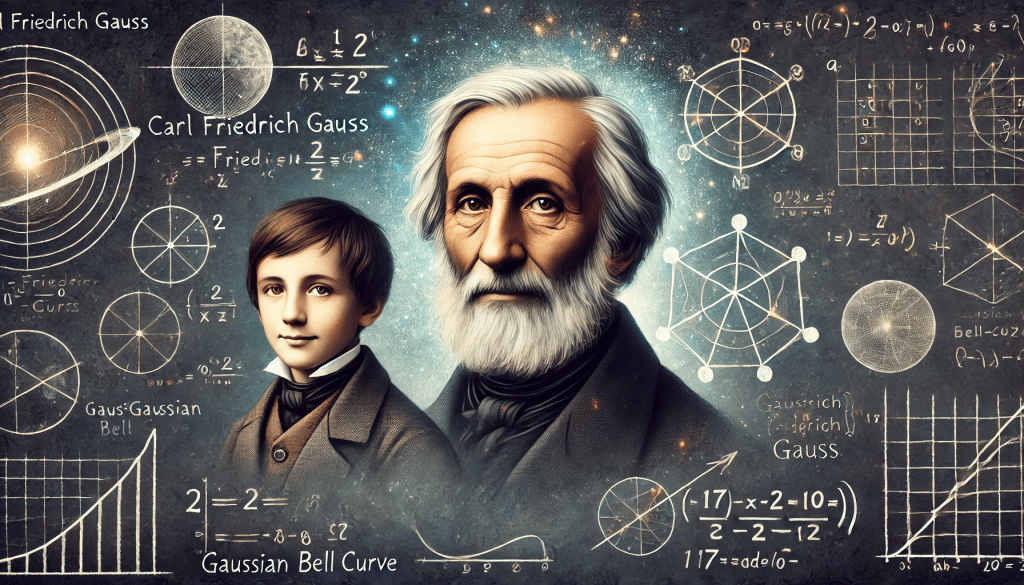
By age seven, Gauss’s mathematical gifts were undeniable. In a now-famous classroom incident, his teacher, Büttner, tasked the class with summing the numbers from 1 to 100—a tedious assignment meant to keep the children busy. Gauss, however, saw the problem differently. Within seconds, he wrote down the answer: 5050. How? He noticed a pattern: pairing the numbers from opposite ends (1+100, 2+99, 3+98, etc.) formed 50 pairs of 101. This simple insight not only solved the problem instantly but also hinted at the way Gauss’s mind worked—seeing order where others saw chaos.
From Dim Candles to Bright Discoveries
Gauss’s early education was far from easy. His family’s financial struggles meant that even basic necessities were a luxury. Determined to learn, young Carl crafted makeshift candles to study at night. By their flickering light, he devoured Euclid’s Elements, questioning the very foundations of geometry. This curiosity led him to challenge Euclid’s fifth postulate, the parallel postulate, laying the groundwork for his revolutionary work in non-Euclidean geometry.
His extraordinary talents eventually caught the attention of the Duke of Brunswick, who became Gauss’s patron. This support allowed him to study at the prestigious University of Göttingen, where his genius flourished. At just 19, he solved a mathematical puzzle that had baffled scholars for centuries: constructing a regular 17-sided polygon using only a compass and straightedge. Gauss was so proud of this achievement that he requested the shape be engraved on his tombstone—a wish that was unfortunately not honored.
A Mind Beyond Numbers
Gauss’s contributions spanned far beyond pure mathematics. One of his most practical and enduring achievements was his work on planetary orbits. In 1801, astronomers discovered a new dwarf planet, Ceres, but lost track of it due to its faintness and orbital complexity. Using his mathematical methods, Gauss calculated its orbit with unprecedented precision, enabling astronomers to locate it almost exactly where he had predicted. This work not only cemented his reputation but also revolutionized the field of astronomy.
In his analysis of errors in astronomical observations, Gauss described what we now know as the Gaussian distribution or the bell curve. This simple yet profound concept underpins modern statistics, physics, and countless scientific fields. Gauss didn’t stop there—he delved into magnetism, discovering that the Earth’s magnetic field originates from its core, work that remains foundational to this day.
The Personal Struggles of a Genius
Behind his extraordinary mind was a man who faced significant personal challenges. Gauss married Johanna Ostoff in 1805, and the couple shared a deep and loving bond. However, tragedy struck just four years later when Johanna died during the birth of their third child. Gauss was devastated, and the loss left a permanent scar on his heart. To make matters worse, the newborn also passed away shortly after.
Seeking stability, Gauss remarried two years later to Minna Waldeck, a friend of Johanna. While their marriage provided companionship, it lacked the warmth and passion of his first. Together, they had three more children, but Gauss faced further losses when Minna fell ill and passed away in 1831, followed by the death of his mother, who had lived with him for much of her life.
Gauss’s relationships with his children were complex. He was a perfectionist, expecting the same dedication to precision and excellence from his family that he demanded of himself. This created tension, particularly with his eldest son, Eugen, who longed for independence and adventure. Their disagreements eventually led Eugen to emigrate to America, a decision that deeply hurt Gauss, though he rarely expressed his emotions openly.
Turning Problems into Tools
Throughout his life, Gauss demonstrated an incredible ability to transform problems into opportunities. He believed that with the right mindset, challenges could become tools for discovery. This philosophy is evident in his work on the Fundamental Theorem of Arithmetic, which proved that every whole number can be uniquely expressed as a product of primes—a result so foundational that it underpins modern number theory.
His work on non-Euclidean geometry challenged centuries of mathematical thought, showing that the rules of geometry could change on curved surfaces. This insight would later pave the way for Einstein’s theory of general relativity, connecting Gauss’s work to the very fabric of spacetime.
A Legacy Beyond Time
Gauss’s life was a testament to the power of thought, perseverance, and curiosity. Despite personal losses, financial hardships, and the limitations of his time, he left a legacy that continues to shape our understanding of the world. The unit of magnetic field strength, the gauss, is named in his honor, and his work on planetary orbits, probability, and geometry remains as relevant today as it was in his time.
But perhaps Gauss’s most profound lesson is this: Problems are not obstacles—they are pathways. Whether it’s a mathematical equation, a scientific mystery, or a personal struggle, the key lies in how we approach them. With patience, logic, and a willingness to see beyond the surface, we can transform challenges into opportunities for growth.
As I reflect on Gauss’s life, I’m reminded of the quiet power of curiosity and the enduring impact of a single mind willing to think deeply. His story isn’t just about mathematics—it’s about the infinite possibilities that emerge when we dare to look beyond the obvious and embrace the beauty of problems waiting to be solved.
 MindsWideOpen.In - AI ⚡ AI 🚀
Leave a comment