
Credit / Reference: https://www.freertos.org/implementation/a00011.html
Introduction: A Retrospective on Real-Time Systems at ITI
Rewind to the bustling R&D labs of the late ’80s at Indian Telephone Industries (ITI), where teams like ours were pioneering data communication and real-time embedded systems. As part of the Switching division, I was among a dedicated crew tasked with creating a preemptive multitasking operating system—a system where time and resources were critical, and every millisecond mattered. At the heart of our efforts was the concept of the idle task—an understated element that would become an important lesson in both technological design and personal growth.
Real-Time Systems: The Role and Value of Idle Tasks
In a real-time OS, the scheduler’s job is to keep the system’s timing and task orchestration at peak performance. A preemptive multitasking system operates by dividing processor time into precise slots, where tasks are given slices of execution time based on priority and need. Our scheduler pulsed every 10 milliseconds, an interval meticulously chosen for the Switching systems we were developing. Here, tasks would either complete within their assigned slots or preempt those of lower priority to meet strict timing constraints.
The idle task comes into play when no other tasks need to run. Think of it as a default, low-priority task that consumes CPU cycles only when the system is otherwise unoccupied. This idle task doesn’t perform critical work—it runs maintenance routines or simply conserve power. At first glance, it might seem unnecessary, but the idle task is crucial. A system that regularly invokes its idle task is a healthy system, indicating that high-priority tasks are being managed efficiently, and resources are balanced. This idle state becomes a barometer of system health—a way to confirm that high-demand tasks are handled, and the system is not under strain.
The Technical Dance of Task Management
To achieve this, the real-time OS leverages two main concepts: context switching and interrupt handling. Context switching allows the system to save the current state of a task, move to a higher-priority task, and then return to the original task later. Our scheduler’s 10-millisecond rhythm was tight but crucial for the timely response expected of ITI’s telecommunication systems.
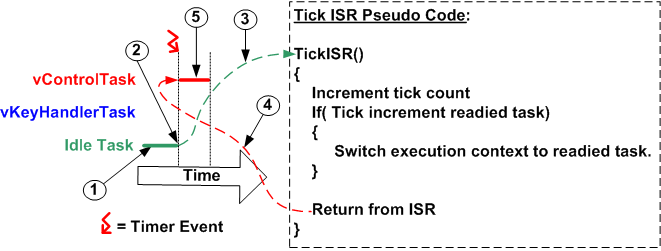
Credit / Reference: https://www.freertos.org/implementation/a00011.html
Interrupts—signals that inform the processor of an urgent event—are central to real-time task handling. When an interrupt triggers, the OS pauses lower-priority tasks to handle the more critical event. After completing the interrupt, the scheduler either returns to the preempted task or checks the queue for another task that might need immediate attention. In this ecosystem, the idle task becomes not just filler but an opportunity for resource monitoring, diagnostics, and power management—tasks essential for the overall health and efficiency of the system.
Idle Moments in Life: Drawing Parallels from System Design
This intricate dance within the OS sparked a broader realization for me: just as an operating system needs idle tasks, we, too, need idle moments in our lives. Much like our system’s idle task, these moments of pause, though often undervalued, serve a deeper purpose.
In our relentless drive for productivity, we often shun idle moments, filling them with busyness or distractions. Yet, in both systems and life, this idleness can be profoundly restorative. Idle moments in life—times when we allow ourselves to pause and reflect—mirror the way an idle task helps the system recalibrate and stay balanced. When we constantly strive to stay “busy,” we risk resource depletion, mental strain, and burnout. But when we embrace downtime, our minds, like a well-functioning OS, recharge, recalibrate, and open doors to creativity and clarity.
Technical Lessons Transformed into Personal Insights
1. System Health Through Idle Time: In a real-time OS, idle time indicates that the system is performing well. If no time is spent in the idle task, it may signal that the system is overburdened or inefficient. Similarly, if we find ourselves with no idle moments in life, it may suggest we’re overloaded, leading to mental or emotional strain.
2. Resource Monitoring and Power Management: An idle task can check the system’s resources, run diagnostics, or reduce power usage. In life, idle moments allow us to gauge our own “resource” levels—our mental, physical, and emotional reserves. Like an OS entering a low-power state, these pauses help us conserve energy and focus on the essentials.
3. Priority Realignment: Preemptive scheduling in an OS ensures high-priority tasks are handled first, relegating less critical tasks to the idle task. When we pause in life, we create space to reassess priorities, redirecting our energy towards what truly matters and relegating trivialities to the background.
Practical Application: Embracing Idle Moments as a Productivity Strategy
To apply these insights, we can start by building intentional “idle tasks” into our routines. Here are a few examples inspired by our OS design principles:
• Scheduled Pauses: Set aside intentional breaks in your day. Much like the OS scheduler, regular, short pauses allow us to return to tasks refreshed and more focused.
• Priority Checks: Use idle moments to re-evaluate your to-do list. Just as an OS promotes tasks based on priority, these moments help you determine where your attention is best invested.
• Resource Conservation: Reduce unnecessary tasks that deplete your energy. In life, this means identifying and eliminating distractions that prevent you from meaningful productivity.
Conclusion: Redefining the Role of Idle Time in Success
Our time with real-time operating systems taught us the profound efficiency of idle tasks, transforming what seemed like an inconsequential aspect into a pivotal part of system performance. Idle moments, whether in an OS or in life, are not mere pauses but opportunities for recalibration, resource conservation, and enhanced efficiency.
So, as we continue our professional and personal journeys, let’s challenge the belief that busyness is the only path to success. Let’s find a balanced rhythm—one that alternates between action and reflection, work and pause, like the well-tuned scheduler in a thriving real-time system. Just as the idle task keeps the OS healthy, these pauses keep us resilient, grounded, and innovative.
Welcome to the dance of efficiency—where the beauty of idle time reveals the path to a balanced, purposeful life.

 MindsWideOpen.In - AI ⚡ AI 🚀
Leave a comment