
In the United States, every four years, a grand and complex game unfolds to choose the next President. To an outsider, it might seem as simple as casting votes and picking the person with the most — but beneath the surface, this game reveals its quirky rules and an unusual twist.
Imagine this: two major teams, Republicans (Team Red) and Democrats (Team Blue), are each tasked with finding their best player, their “champion,” to represent them in the final competition. Through primaries and caucuses in each state, they settle on their top contenders, who will then go head-to-head in the ultimate national showdown.
In the 2024 election, the Democrats have chosen Vice President Kamala Harris as their champion, while the Republicans have selected former President Donald Trump. (CNN)
But the national game doesn’t treat each vote as equal across the country. Instead, each state becomes its own battlefield, carrying points known as electoral votes, based on its population. Some states, like California with 55 points and Texas with 40 points, are electoral giants, while others, like Wyoming with 3 points, are much smaller players. The goal is clear: the first champion to reach 270 electoral votes wins. Simple? Not quite.
Here’s where the story takes a twist. In nearly every state, the rule isn’t “take some, leave some.” It’s all or nothing.
If a champion wins the vote in a state — by even a single vote — they claim all the state’s points, thanks to the winner-takes-all rule. So, in a state like Florida, with 29 electoral votes, a champion could win by the tiniest margin yet walk away with the entire prize, while the runner-up leaves with absolutely nothing. It’s like winning the jackpot with a single lottery ticket.
Because of this system, not all states matter equally. Some are reliably “safe” for one team: California (55 electoral votes) and New York (28 electoral votes) almost always go to the Democrats. These Democratic-leaning states are known for their progressive, urban centers, which tend to support policies that align with Democratic values, like environmental action and social welfare programs.
On the flip side, states like Texas (40 electoral votes) and Alabama (9 electoral votes) are nearly guaranteed to support Republicans, with deeply rooted conservative values centered around limited government, lower taxes, and traditional social structures. These states are often more rural or suburban, with strong cultural identities tied to Republican principles.
Surefire States: Why Some States Lean One Way
These so-called surefire states form the electoral foundation for each team. The Democrats rely on their strongholds in coastal, urbanized areas where large cities and diverse populations often align with their platform. Republicans, on the other hand, draw strength from the South and the Midwest, where agricultural economies, a focus on family values, and a conservative approach to governance tend to prevail.

Top 10 States with the Most Electoral Votes:
1. California – 55 electoral votes (leans Democratic)
2. Texas – 40 electoral votes (leans Republican)
3. Florida – 29 electoral votes (swing state)
4. New York – 28 electoral votes (leans Democratic)
5. Pennsylvania – 20 electoral votes (swing state)
6. Illinois – 19 electoral votes (leans Democratic)
7. Ohio – 17 electoral votes (swing state)
8. Georgia – 16 electoral votes (swing state, leaning Republican)
9. Michigan – 15 electoral votes (swing state, leaning Democratic)
10. North Carolina – 15 electoral votes (swing state)
Among these, some — like California, New York, and Texas — are consistently safe for one team. But others, like Florida, Pennsylvania, and Michigan, are the unpredictable swing states that both parties keep a close eye on..
And so, in the end, this national game often comes down to a few key swing states. The winner might not even need the most votes from the entire country but just the right mix of wins across these decisive states. And when the magic number — 270 — is reached, the champion is declared President, taking the reins of a nation in a system uniquely American, where strategy, geography, values, and the all-or-nothing approach all play a curious role.
In this race to 270, it’s not about winning everywhere — it’s about winning in just the right places.

Appendix – Democrats Vs Republicans
Religion, Values, and the R vs. D Divide
Beyond geography and voting systems, one of the biggest divides between Republicans and Democrats involves religion and values. Generally, Republicans see religion, particularly Christianity, as central to both personal life and public policy. Their policies often reflect traditional Christian values on issues like family, education, and social programs, as they believe America’s moral and cultural roots are deeply tied to Judeo-Christian teachings.
Democrats, however, tend to support a more secular approach, advocating for religious freedom in a way that includes diverse beliefs and emphasizing the separation of church and state. While many Democrats are religious, they often focus on individual freedom and inclusivity, crafting policies that ensure a pluralistic society where no single religion dictates public life.
In short, Republicans often see religious values as a guiding force in law and social norms, while Democrats prioritize personal freedom and the inclusivity of all beliefs, reinforcing a more secular public sphere. This difference plays into party policies and is a significant factor in how they approach core issues, from healthcare to education.
The symbol for the Democratic Party is the donkey. This symbol has been associated with the party since the 19th century, often seen as representing qualities like hard work, humility, and determination. The donkey became widely recognized as a symbol for Democrats after political cartoonist Thomas Nast popularized it in the 1870s. Today, it’s used alongside the color blue to represent the Democratic Party.
The symbol for the Republican Party is the elephant. This association dates back to the 1870s, when political cartoonist Thomas Nast used the elephant to represent Republicans in a series of cartoons. The elephant is often seen as a symbol of strength, dignity, and stability. Today, the elephant, along with the color red, is widely recognized as the emblem of the Republican Party.
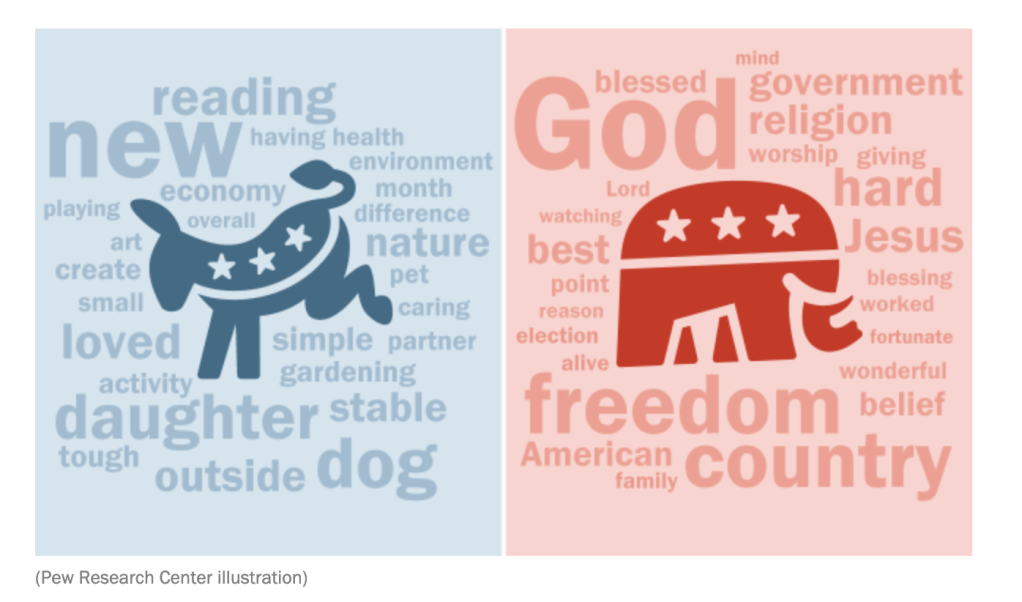
This image from the Pew Research Center visually represents the different values and priorities often associated with supporters of the two major U.S. political parties, Republicans and Democrats, by using word clouds.
Left Side: Democrats (Blue, Donkey Symbol)
The words here are related to themes of new experiences, environment, health, and relationships. The prominent words include:
• New, reading, nature, health, environment, art, create, simple, stable, loved, tough: These words highlight a focus on creativity, personal growth, and environmental and social well-being.
• Words like daughter, dog, partner suggest values associated with relationships and caring for loved ones and pets.
• Economy and overall are included but are less prominent, indicating these may be of interest but not necessarily central.
The word cloud suggests that Democratic supporters often emphasize personal well-being, stability, environmental care, and inclusivity. Their focus leans more toward progressive values like health, nature, and a balanced life.
Right Side: Republicans (Red, Elephant Symbol)
The words on this side focus more on themes of faith, patriotism, and hard work. Key words include:
• God, freedom, country, family, American, religion, hard, government: These words point to traditional values related to faith, patriotism, and a strong emphasis on family and country.
• Jesus, belief, blessing, fortunate, best reflect a religious or faith-based orientation that is commonly associated with Republican values.
• Words like giving, wonderful, reason, election, worked emphasize a sense of purpose, self-reliance, and hard work.
This side of the word cloud suggests that Republican supporters often value faith, freedom, patriotism, and resilience. Their focus tends to lean more toward traditional, religious, and patriotic principles.
Summary
The illustration highlights the contrasting priorities between the two groups:
• Democrats (left): Emphasis on relationships, health, nature, creativity, and stability.
• Republicans (right): Emphasis on faith, patriotism, freedom, family, and hard work.
These word clouds encapsulate the cultural and ideological differences that often define the two parties’ values and their approaches to life and governance.

 MindsWideOpen.In - AI ⚡ AI 🚀
Leave a comment