
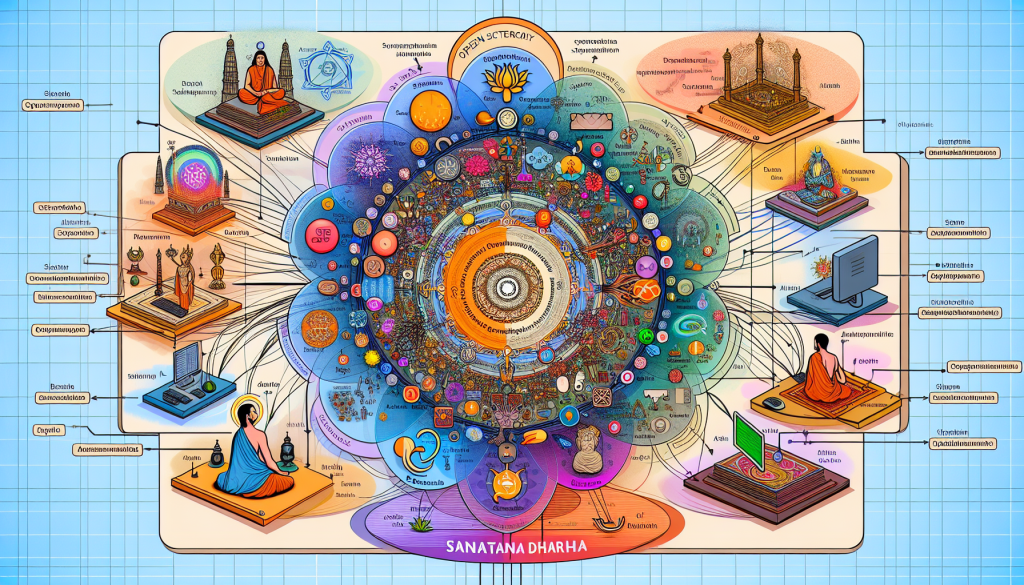
In a recent contemplation, I arrived at a fascinating analogy that likens Sanatana Dharma to an open-source operating system. This perspective allows us to view Sanatana Dharma not just as a religion, but as a foundational layer upon which various applications—representing different beliefs and practices—can be built and deployed within the receptive hardware of human minds. This analogy is compelling because it underscores the importance of analytical and logical consistency in Sanatana Dharma before the formation of any belief.
Extending this analogy, we might leverage concepts from Object-Oriented Analysis and Design (OOAD). In this paradigm, Sanatana Dharma is akin to the superclass of an object-oriented system, encapsulating core functionalities: the immutable principles of Brahman (the Supersoul or Ultimate Truth), Atman (the individual soul), Prakriti (material nature or space), Kaal (eternal time), Dharma (righteousness), and Karma (actions and their repercussions).
From this universal superclass, a myriad of subclasses can be derived. These subclasses represent the various paths and interpretations within Sanatana Dharma, including the diverse yogic practices (Bhakti Yoga, Karma Yoga, Jnana Yoga), rituals, and philosophical schools (Advaita, Dvaita, Vishishtadvaita), each with its own unique methods and attributes. Here’s a brief outline of how these philosophical schools branch out:
| Aspect | Advaita Vedanta | Dvaita Vedanta | Vishishtadvaita Vedanta |
|---|---|---|---|
| Core Principle | Non-duality of Atma and Brahman | Dualism between Atma and Brahman | Qualified Non-duality |
| Brahman | Without attributes (Nirguna) | With attributes, a personal deity (Saguna) | With attributes, both personal and universal (Saguna) |
| Universe (Jagat) | Illusory (Maya) | Real and distinct | Real and part of Brahman |
| Atma (Soul) | Identical to Brahman | Distinct and individual | Distinct yet linked to Brahman |
| Liberation (Moksha) | Through self-knowledge (Jnana) | Through divine grace | Through devotion and surrender (Bhakti and Prapatti) |
| Interpretation of Scriptures | Symbolic or metaphorical | Literal | Contextual and literal |
These subclasses inherit from Sanatana Dharma but also introduce unique properties and methods. For instance, Bhakti Yoga may emphasize devotional activities such as chanting and temple rituals, while Jnana Yoga provides a framework for intellectual understanding and scriptural study.
| Yoga Path | Focus | Methods | Ideal Practitioner |
|---|---|---|---|
| Bhakti Yoga | Devotion to the divine | Chanting, rituals, temple worship | The devout, seeking a personal connection with God |
| Karma Yoga | Selfless action | Service without attachment to outcomes | The active, looking to find spirituality in daily life |
| Jnana Yoga | Knowledge and wisdom | Study, contemplation, meditation | The philosophical, seeking direct insight into truth |
This object-oriented paradigm maintains the core tenets of Sanatana Dharma while supporting a rich diversity of expressions, evolving with the needs and insights of its adherents. Much like in software design, where new classes can be created or existing ones extended to introduce novel features without disrupting the overarching structure, Sanatana Dharma’s framework is stable yet adaptable, capable of responding to spiritual and cultural developments across time.
Thus, Sanatana Dharma operates as a sophisticated, structured, yet dynamic spiritual system, allowing for the coexistence and interaction of various paths under a shared, overarching divine codebase. It ensures that while individual expressions and practices may vary, they remain aligned with the central doctrines, preserving the system’s integrity. This model emphasizes Sanatana Dharma’s multi-layered, open-ended nature, continually evolving and enhancing through contributions from a vast community of practitioners.
 MindsWideOpen.In - AI ⚡ AI 🚀
Leave a comment